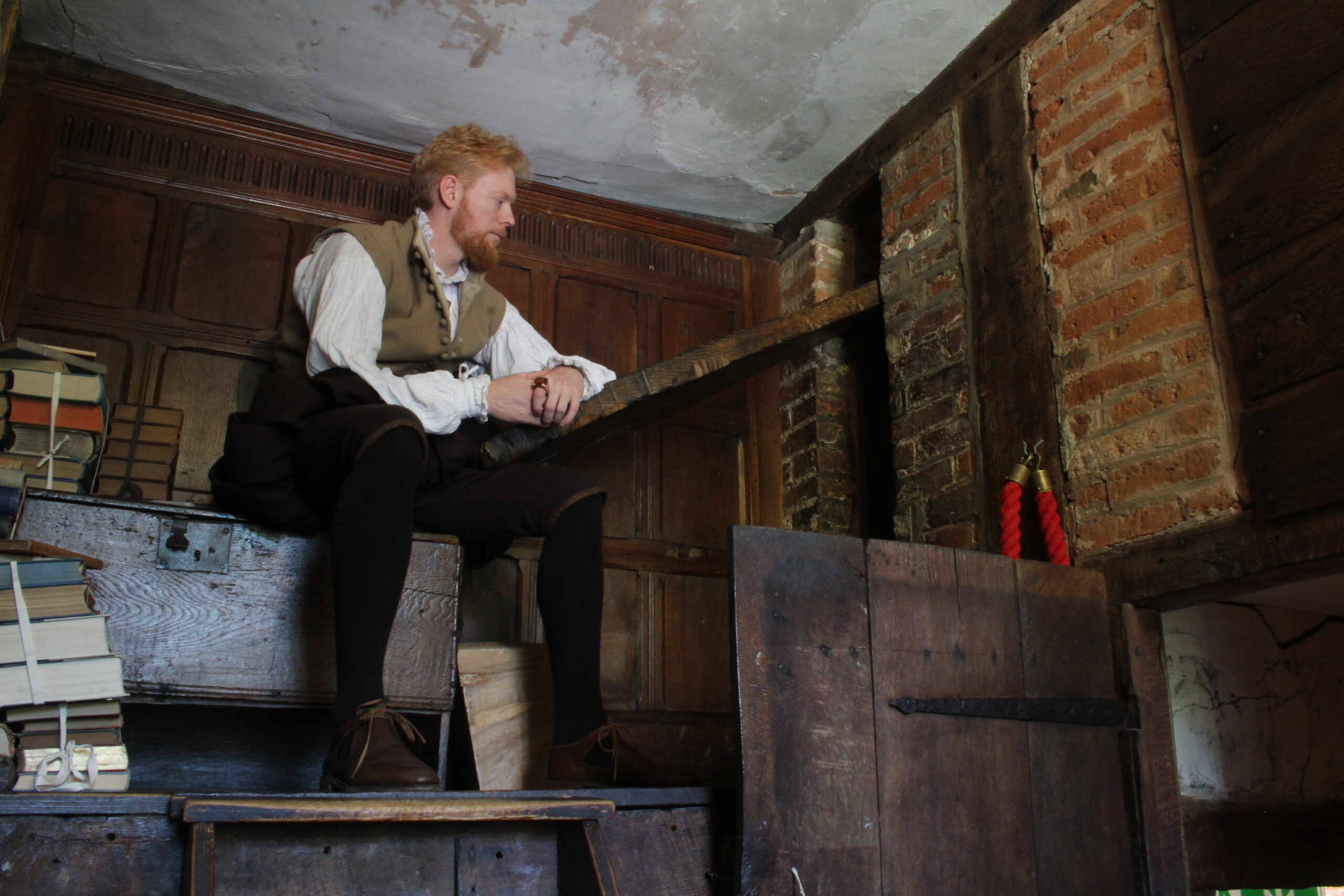
21 April 2026
Back in January 2026, I visited some dear friends who live in the delightful North Yorkshire market town of Pickering. Whilst I waited for them to finish work, I pottered around the castle (brilliant garderobes), church (excellent wall paintings), and local bookshop (fabulous folklore section). The latter really was amazing, and I was very much taken with the redundant roof structure that dominates the upper floor. I got talking with the shop attendant who repeated a now familiar phrase: “Oh, those timbers are supposed to come from old ships, and the house opposite has got a priest hole!” Anyone familiar with my work may know that I’ve investigated ship timber rumours a fair bit, including for this blog, but I haven’t yet addressed the subject of priest holes…

Diate Hill Tower at Pickering Castle (left), wall painting at St Peter & St Paul at Pickering (centre), and the roof structure of The Pickering Book Tree (right); (Picture Source: James Wright / Triskele Heritage)
There are a couple of reasons that I have previously overlooked priest holes. First, their use falls outside the mediaeval period. Second, although I wanted to discuss them in the Historic Building Mythbusting book, I had reached the publisher’s word limit and couldn’t fit the subject in. The motive for picking up on priest holes now is because, whenever I talk about the lack of evidence for secret passages at public events, many people ask: ‘But what about priest holes!?’ Well, the time has come to look at them in connection to both vernacular architecture and hidden tunnel rumours.
Terminology
The first recorded use of the term ‘priest hole’ was by the diarist Samuel Pepys in 1660. According to the Oxford English Dictionary, it is understood to mean: ‘A secret chamber or similar hiding place for a Roman Catholic priest, esp. in Elizabethan and Jacobean England.’ However, Pepys was writing decades after the heyday of such features. During the late sixteenth and early seventeenth century, a variety of terms were employed in accounts by priests, landowners, and spies to describe hiding places including: ‘more retired places’, ‘secret convenience’, and – especially – ‘secret place’ (quoted in Hodgetts 1989, 9, 10, 12). In more recent times, the alternative phrase ‘priest hide’ reflects that many were ingenious constructions rather than mere holes. Nonetheless, in this blog, I’m going to use Pepys’ near-contemporary early modern terminology – priest hole – as it is the most familiar phrasing to modern readers.
Vernacular Assumptions
Unlike secret passages, priest holes are Very Definitely An Actual Thing. The problem is that their existence is assumed to be far more common in all types of houses than historic reality supports. In his book Secret Hiding Places, Michael Hodgetts (1989, iv) noted that priest holes are usually only to be found within the high-status properties of the early modern recusant Catholic gentry. This level of society was more capable of financially supporting their own recusancy (which was punishable by high financial penalties), accommodating priests, and patronising master carpenters to create ingenious hiding places. With a very small number of exceptions, priest holes are not generally anticipated in non-elite vernacular houses. This would tend to rule out 41, 42 and 44, Burgate which the bookseller in Pickering suggested as having a priest hole. Aside from the building falling below the social status which would normally contain one, the Burgate property is probably eighteenth century in date – a period long after priest holes were constructed.

41, 42, and 44, Burgate, Pickering, North Yorkshire (Picture Source: Rightmove)
I have encountered rumours of priest holes in vernacular buildings too numerous to quantify. The landowner of a timber-framed farmhouse in Worcestershire showed me a space beneath a staircase barely big enough to contain a domestic cat. Despite the apparent lack of archaeological evidence, a sign outside the Red Lion in York claims that there is ‘a priest hole on the 1st floor which leads to a hidden room up in the attic’. Meanwhile, pretty much any aperture of uncertain function seems to be assigned as a priest hole by commentators on internet discussion groups. One such example comes from a Welsh farmhouse considered on the Medieval & Tudor Period Buildings Group. A horizontal slot measuring approximately 0.3m (width) x 1.5m (length) was conjectured to be a priest hole because: ‘People were known to be smaller in medieval times’. Aside from the fact that priest holes are an early modern phenomenon, the latter is also a fallacy as my colleague, the osteoarchaeologist, Dr Lauren McIntyre can testify. The mean height for English males alive between 1400 and 1650 was 1.73-1.74m (Galofré-Vilà, Hinde, & Guntupalli 2018, 67-98). Too big for the slot in Wales.
This is not to say that priest holes were never a feature in vernacular properties. In his biography of the sixteenth century Catholic martyr Margaret Clitherow (c 1556-1586), the fugitive priest, John Mush described a hiding place in a York house. Clitherow, who lived at 10-11 Shambles, arranged access from her property into the adjacent attic above her neighbour’s house. Mush indicated that it was then possible to climb down from the attic into the chamber below (quoted in Hodgetts 1989, 120-21). Although this does sound, at face value, to be a description of a priest hole in a vernacular building there may be other factors at play. First, Clitherow was of relatively high social standing – her father was Sheriff of York in 1564, and her husband was Chamberlain of the City. Second, it has been conjectured that Margaret’s conversion to Catholicism, and support for priests, may have been encouraged by Dorothy Vavasour. She was the wife of the socially prominent, Cambridge-educated physician, Dr Thomas Vavasour. The latter was himself arrested, in 1574, within what may have been the earliest priest hole known to the documentary record. Third, I am not certain that Mush’s description reads that much like a genuine priest hole. Instead, it may have been a rudimentary access between two attics which then communicated, via a hatch, with the bedchamber below. Although some care may have been taken to mask the entrances the ad hoc engineering may have been too primitive to be considered a priest hole proper.

10-11 Shambles, York, North Yorkshire (Picture Source: Warofdreams / Wikimedia Commons)
Lingering doubts about the Clitherow hiding place aside, there are relatively few priest holes in vernacular buildings which are known from documentary or archaeological evidence. Most claims from vernacular houses can be rejected as a misunderstanding of more prosaic architectural features. Instead, as many authors have noted, priests were hidden ‘uncomfortably about the country houses of Elizabethan England’ (Errand 1974, 14).
Real Priest Holes
The material existence of priest holes is tangible evidence for the Counter-Reformation in England. Following the Rising in the North (1569), excommunication of Elizabeth I by Pius V (1570), and the secretive re-introduction of Catholic seminary and Jesuit priests to England during the 1570s and 1580s; the Elizabethan state made the shelter of clerics an offence of high treason in 1584. A resultant conference of recusant Catholic families, held at Harleyford Manor (Buckinghamshire) in 1586, decided to covertly position priests within households for long periods of time. This was to avoid the suspicion created by constant movement between locations. Additionally, it led to the need for clever hiding places in case of government sponsored searches (Hodgetts 1989, 3-9).
Although priest holes were known prior to 1586, at places such as Ripley Castle (North Yorkshire) and Lyford Grange (Oxfordshire), they became more common after this date (Hodgetts 1989, 9, 12). The heyday for their construction was the period between the Harleyford conference of 1586 and the Gunpowder Plot of 1605. It probably included those constructed at Coughton Court (Warwickshire), Scotney Castle (Kent), and Speke Hall (Merseyside). All three are managed by the National Trust and can sometimes be seen by the public.

Priest hole at Coughton Court, Warwickshire (Picture Source: Brian Robert Marshall / Wikimedia Commons)
The acknowledged master craftsman of priest holes was the carpenter and Jesuit lay brother Nicholas Owen (c 1562 – 1606). Between 1588 and 1606, he constructed numerous examples across the country; although documentary evidence can only link him directly to those at Baddesley Clinton (Warwickshire) and Broadoaks Manor (Essex). At the former, Owen remodelled a sewer outfall, 0.5m wide by 1.2-1.8m in height, which discharged into the moat. Initially, he constructed a new garderobe turret with a separate chute. Then he blocked up the older outlet and created a hidden entrance within the original garderobe. The ruse worked so well that Father John Gerard, and around 8 or 9 others, successfully hid from a party of ‘four Priest-hunters’ in October 1591 (Reynolds 2014, 41-46). Gerard was similarly successful in evading capture at Broadoaks Manor during the spring of 1594. Here, the chapel was at the top of the house. Beneath the hearth of a fireplace in the room, Owen dug a hole in the masonry measuring approximately 2m (length) x 0.6m, (width) x 1.9m (height). The hiding place was concealed so adeptly that it foiled the pursuivants during an extended search that lasted four days (Reynolds 2014, 48-54).

Priest hole at Baddesley Clinton, Warwickshire (Picture Source: James Wright / Triskele Heritage)
A priest hole, that is also suspected to have been created by Owen, at Oxburgh Hall (Norfolk), relied on the conversion of another garderobe (Forest 2014, 25). Located within a chamber off the late fifteenth century brick gatehouse, the hiding place was created by digging down and then into the masonry for approximately a metre. The aperture then opened upwards into a relatively large space – 1.3m (length) x 0.9m (width) x 2.5m (height). Within, the chamber was provided with a wooden seat, recesses for books, a secondary cavity for vestments, and even a concealed tube for the supply of liquid refreshment from the adjacent bedroom. The entrance was hidden behind an oak frame, clad with floor tiles, which pivoted open. So well-appointed was this hiding place that it has been described as ‘a palace among priest-holes’ (Reynolds 2014, 106-08).

Priest hole at Oxburgh Hall, Norfolk (Picture Source: James Wright / Triskele Heritage)
The house that is perhaps best known for priest holes is Harvington Hall (Worcestershire). Between his inheritance in 1578 and death in 1631, the landowner, Humphrey Pakington patronised the creation of no less than eight surviving hidden spaces at the house (Reynolds 2014, 111-15; Anon 2023, 7, 11, 19, 27, 29, 33, 37, 45, 47). They include:
- A priest hole, measuring 0.8m x 1.1m x 1.5m, above the bread oven in the Great Kitchen which was accessed from a garderobe off the South Room Bedchamber.
- A pair of steps at the top of the Great Staircase which were hinged to allow access to a small chamber beneath.
- Beyond the latter was a secondary hiding place, measuring 1.5m x 1.8m x 1.8m, accessed via a door camouflaged with brickwork.
- A pivoting false wall stud in Dr Dodd’s Library allowed access to a chamber 0.9m x 2.4m 1.5m in dimension.
- A passageway off the Withdrawing Room contained a trapdoor that opened on to a ladder down into a chamber, measuring 0.6m wide x 1.3m in length, which was created by building a false sandstone wall against a chimney.
- In the Chapel was a small recess under the floorboards, just 0.18m deep, probably used for hiding priest’s vestments.
- In the Marble Room was a false fireplace, artificially smoke-blacked, that granted access into the roof structure. After negotiating a crawl space, the priest could then drop down into a large chamber measuring 5m x 4m x 2m.
- Also within the roof structure was another small chamber, measuring 1m x 1m x 2.4m, probably used for hiding massing equipment.

Priest hole at Harvington Hall, Worcestershire (Picture Source: James Wright / Harvington Hall)
It is no wonder that commendations for the ingenious hiding places at Harvington Hall are legion: ‘the finest collection of hides surviving in Britain’ (Reynolds 2014, 112); ‘the most celebrated priests’ holes’ (Errand 1974, 18); and ‘The finest surviving series of hiding-places under one roof’ (Hodgetts 1989, 81).
Jumping to Conclusions
Despite the reality of priest holes in some early modern houses, the discovery of almost any hidden space, of apparently uncertain provenance, can lead to erroneous identification. Whilst I was working on an archaeological building survey at Knole (Sevenoaks, Kent), in 2013, the chance discovery of a void led to such speculation. A 0.48-metre-wide cavity was recorded between the roof structures of the Pheasant Court Building, to the west, and the Chapel, to the east. During a site meeting between the MOLA archaeologists, conservation practitioners, and the National Trust one of our number said: “Surely, it’s a priest hole!” Everyone became immediately animated and excited. Priest holes cast a spell.

Detail of roof structures of the Chapel and Pheasant Court Building at Knole, Sevenoaks, Kent (Picture Source: James Wright / MOLA)
Chronologically, the Pheasant Court Building dates to the period 1445-50 and it had a gable end with moulded principal trusses. Stratigraphically, the cavity was created in the 1460s when the Chapel was added to the east of the Pheasant Court Building and blocked the view of the mouldings. This was more than a century before the first known priest hole, at a time when England was firmly Catholic. Furthermore, even after the Reformation, Knole was in the hands of the Lennards and then Sackvilles – both staunchly Protestant families unlikely to have been harbouring Catholic priests (Topsell 1597, no page number; Town 2010, 88).
The cavity was probably incorporated between the two builds as an inspection chamber for the roof structure of the Chapel. There was a doorway from the gable of the Pheasant Court Building which led into the cavity. From the cavity was a hatch which accessed the Chapel roof. Although the latter did not incorporate a floorboarded attic, it was meant to be accessible as indicated by the presence of a small window lighting the east gable. The value of such an inspection chamber can be proven by the charred timbers on some of the rafters of the Chapel – evidence of fire damage which did not take hold more significantly. However, there is no evidence for a priest hole, and we must be careful not to jump to conclusions.
The Link to Secret Passages
The author, Allan Fea (1901, 19-20) believed that priest holes were abundantly common: ‘In the mansions of the old Roman Catholic families we often find an apartment in a secluded part of the house or garret in the roof named “the chapel,” where religious rites could be performed with the utmost privacy, and close handy was usually an artfully contrived hiding-place, not only for the officiating priest to slip into in case of emergency, but also where the vestments, sacred vessels, and alter furniture could be put away at a moment’s notice’ (emphasis my own). Meanwhile, Granville Squiers (1934, 16) was confident that: ‘It is noticeable in [Nicholas] Owen’s work that he nearly always contrived an emergency exit or bolt-hole to his hides’. Here we see the published basis of two assumptions which have filtered into common beliefs about priest holes: 1) that they were very common and, 2) that they were connected to escape routes.
It is tricky to gauge the number of priest holes. Tony Reynolds (2014, 103) made ‘a reasonable guess’ that Nicholas Owen was responsible for the construction of ‘perhaps 150-200 hides of various sizes in the course of his career.’ This is perhaps an optimistic upper limit. Writing with typical good-humoured scepticism, Jeremy Errand (1974, 14) estimated ‘More than a hundred ancient Catholic houses in this country have crannies that are claimed to be priests’ ‘holes’ or hiding-places and scores of them are genuine. A large proportion of the houses are also endowed with legends of secret passages. The authenticity of these is more doubtful.’ Such cynicism was matched by, the great cataloguer of priest holes, Michael Hodgetts, who regretted that ‘Victorian owners of country houses convinced themselves that every old closet was a priest-hole and every old conduit or sewer a secret tunnel’ (Hodgetts 1989, 1). It is significant that both Errand and Hodgetts recorded the popular assumption that priest holes were routinely furnished with secret passages to facilitate escape.
Fea (1901, 79) recorded an early example of this belief at Harvington Hall: ‘A subterranean passage is said to run under the moat from a former hiding place’. Meanwhile, the website Occult World repeated the popular belief in ‘a stone-lined pit called the Kennels, which was said to be linked to the Hall itself by an underground tunnel passing under the moat.’ Elsewhere, Phil Downing (pers. comm., email 26/06/2025), the current manager at Harvington Hall, has reported: ‘Local legend holds that a secret tunnel once ran from Harvington Hall to the Dog pub in the village, offering a hidden escape route for fugitive priests.’ Stories of secret passages are legion. Virtually every single hamlet, village, town, and city in the land has such rumours. It is difficult to think of a country house without an example of such folklore. Harvington Hall is no exception.

Harvington Hall, Worcestershire (Picture Source: James Wright / Triskele Heritage)
Yet, unlike most ancient buildings, Harvington Hall genuinely does have several priest holes. It is suggested that the reality of these hiding places has assisted belief in the unfounded tales of secret passages leading out from the hall. Visitors can inspect most of the hiding places in the house. Many will contemplate the energy-sapping terror that ensnared the clerics hidden within as they listened to the searches which could lead to their excruciating torture and gruesome deaths. It is perhaps natural to project a desire for escape from the enclosed hiding places which might have felt like traps. However, the archaeology does not seem to support this wish. Neither do the engineering practicalities – the house is surrounded by a wet moat, on all sides, that is up to 46 metres wide in places. Meanwhile, Tony Reynolds (2014, 119-20) has noted: ‘It is clear that having two access points would double the chances of discovery and given that up to a hundred men were deployed in searches, making a dash for it from an exit only a few metres away would almost certainly be futile.’
Conclusions
So, when attendees at my talks ask: ‘But what about priest holes!?’, I acknowledge their existence. However, I also note their rarity and the fact that they were confined hiding places rather than escape routes. Yet the presence of these real, secretive, spaces within ancient buildings has helped to give licence for wilder beliefs in hidden tunnels.
The tangible existence of underground features, blocked doors, and mysterious enclosed spaces are always likely to provoke an excited response linked to a fascination with arcane esoterica. As Anthony Clayton (2015, 5) put it in Secret Tunnels of England: ‘the vast majority of these tantalizing tales clearly belong in the realm of folklore, or are fanciful misinterpretations of shallow mines, sewers, drainage tunnels, underground conduits, or closely adjacent undercrofts and cellars with vaults and arches.’ To this list, we can perhaps add: priest holes.
References
Anon, 2023, Harvington Hall. Archdiocese of Birmingham. Birmingham.
Clayton, A., 2015, Secret Tunnels of England – Folklore and Fact. Accumulator Press. London, Hastings & Cosmopoli.
Errand, J., 1974, Secret Passages and Hiding Places. David & Charles. Newton Abbot & London.
Fea, A., 1901, Secret Chambers and Hiding Places. S. H. Bousfield. London.
Forest, A., 2014, Oxburgh Hall. National Trust. Swindon.
Galofré-Vilà, G., Hinde, A. & Guntupalli, A. M., 2018, ‘Heights Across the Last 2,000 Years in England; in Hanes, C. & Wolcott, S., Research in Economic History Volume 34. Emerald Publishing. Leeds. pp67-98.
Hodgetts, M., 1989 (2nd edition, 2024), Secret Hiding Places – Priest Holes: The Incredible True Story of Faith, Courage and Ingenuity. Veritas. Dublin. (2nd edition self-published).
Reynolds, T., 2014, St Nicholas Owen: Priest-hole Maker. Gracewing. Leominster.
Squiers, G., 1934, Secret Hiding Places: The Origins, Histories, and Descriptions of English Secret Hiding Places Used by Priests, Cavaliers, Jacobites and Smugglers. Paul Stanley. London.
Topsell, E., 1597, The Reward of Religion. John Windet. London.
Town, E., 2010, A House ‘Re-edified’ – Thomas Sacville and the Transformation of Knole, 1605-08. Unpublished doctoral thesis. University of Sussex.
Acknowledgements
Thanks to Gary & Clare for inviting me to Pickering; Michelle-Louise for the trips to York, Baddesley Clinton & Oxburgh Hall; Phil Downing and James Brogan for the backstage access to Harvington Hall during May 2025; additional thanks to Dr Martin Toms for being my adventure buddy that day; and to Nathalie Cohen for commissioning the Knole survey.
About the author
James Wright is an award-winning buildings archaeologist. He has two decades professional experience of ferreting around in people’s cellars, hunting through their attics and digging up their gardens. He hopes to find meaningful truths about how ordinary and extraordinary folk lived their lives in the mediaeval period.
He welcomes respectful contact through email or on Twitter, Instagram & Bluesky
The Mediaeval Mythbusting Blog is the basis of the book – Historic Building Mythbusting – Uncovering Folklore, History and Archaeology which was released via The History Press in June 2024. More information can be found here:
